


Clinical trials generate vast amounts of underutilized imaging data. The global clinical trial imaging market is projected to reach $1.91 billion by 2030, as biopharma organizations continue to invest in research and development of novel therapeutics. But after trial sponsors pay to acquire, process and analyze terabytes of imaging data, that data often sits trapped in systems across third parties, sites and trials. As phase III trials fail around 42-45% of the time, much of that investment is wasted if that data can’t be effectively mined for new endpoints.
In this blog, we’ll explore the current landscape for medical imaging data in clinical trials and how sponsors can reclaim their time, money and efforts by revisiting data collected at trials.
The Current Imaging Landscape
For many trial sponsors, the path between acquiring imaging data to actually being able to use it is long and broken. Imaging data is acquired at trial sites in a hospital or clinical setting, then sent through transfer tools to reading center and core lab platforms, and eventually loaded into sponsor repositories and analysis environments. Each system has its own formats and metadata conventions, so every move means another export, conversion or re-upload.
This journey introduces many instances where imaging data changes hands and could be managed in a way that compromises data quality. Sponsors also often work with different vendors across trials and phases. Each organization has its own processes for de-identification and quality control, and responsibility for the data shifts with every handoff.
Throughout this process, data quality may suffer when acquisition varies from site to site or files are converted between formats. Metadata, annotations and provenance may get lost along the way. And every new copy and manual transfer makes security and compliance harder because disconnected systems make it difficult to maintain the unbroken audit trail that requirements like 21 CFR Part 11 demand.
The time it takes for imaging files to make this journey adds up, too. CROs must wait to get reads back from reading centers, which can take 24-72 hours for a read to be cleaned and delivered. And batched reads can take 1-2 weeks to reach CROs, not to mention the months it can take for sponsors to see this data.
The Missed Opportunity
While these data delays may be in line with original clinical trial time estimates, they come into direct conflict with the growing trend of investigating secondary endpoints and exploratory research that show clinical effects beyond what was originally being studied. Research has shown that nearly all Phase III trials have more endpoints, objectives and eligibility criteria than their Phase II predecessors.
There are several reasons for this increase, but a significant factor is expense. When a single clinical trial can range from $4 million to more than $100 million, there’s tremendous commercial pressure on sponsors to make the most of these trials.
Data fragmentation stands in the way of studying secondary endpoints in a timely fashion. It takes time to receive data collected in a clinical trial phase and then analyze that data for other endpoints beyond the primary and secondary ones typically set at the beginning of trials and between phases. With better, faster data access, biopharma companies could:
- Conduct exploratory research faster, finding potential endpoints for future trials
- Design better protocols for the next trial
- Make more informed go/no-go decisions and potentially redirect resources elsewhere
Label Expansion and More
One of the biggest ways biopharma companies maximize trial data is through label expansion. For instance, in 2024, the FDA approved new indications for existing oncology drugs over new oncology drugs by nearly 2-to-1. And certain therapeutics may be prescribed more often for supplemental indications. The rise of GLP-1 prescriptions for weight loss and other uses beyond diabetes management speaks to how label expansion can cause a drug class to explode in the market.
The faster trial sponsors can dig into their existing trial data, the sooner label expansion can happen. Imaging biomarkers, such as tumor size, are commonly accepted as surrogate endpoints for FDA approval on new indications. But they can take years to develop and validate, so sponsors can’t afford additional delays to access and analyze data.
Beyond access, sponsors need to be able to analyze that data effectively. Reusing data effectively depends on having it standardized and labeled correctly, and then searchable by metadata. One leading biopharma company used a centralized imaging platform to make its trial data FAIR (findable, accessible, interoperable and reusable), empowering its teams to effectively dig through more than 200 million images from previous trials.
Untangling the Imaging Pipeline
To strengthen biopharma companies’ ability to receive, access and explore imaging data from clinical trials in a timely fashion, they need to create a through line from sites to CROs, sponsors and reading centers, where imaging files can flow cleanly and quickly, without risk of data loss. This system would need built-in data governance, so all teams are given permission-based access to the same datasets. Data processing tasks like de-identification, format conversion and QA/QC should be automated and repeatable, so that data can be analyzed across different sites and trials. Plus, this system should be validated, so that every change made to data is tracked for FDA requirements like 21 CFR Part 11.
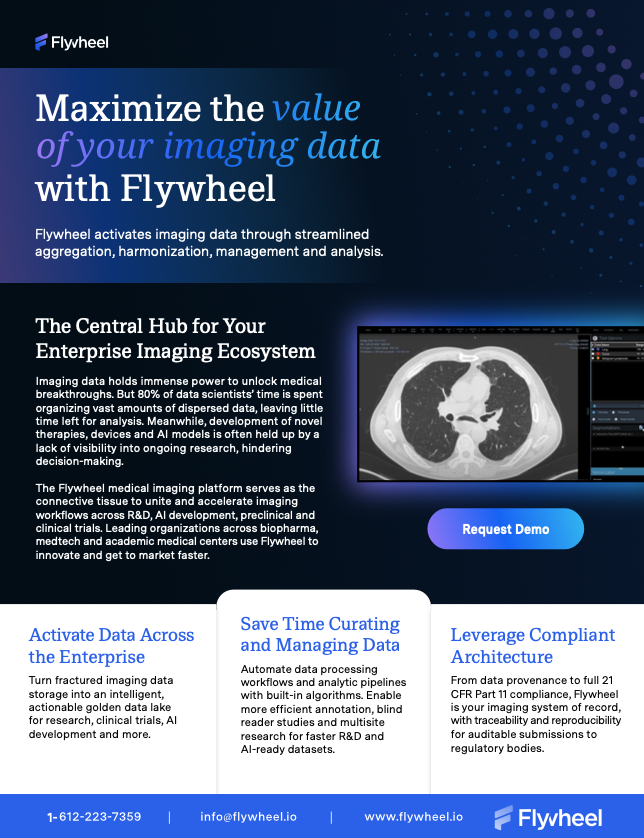
Flywheel already works with 10 of the top 20 biopharma companies to create a central repository for all of their imaging data. These companies have used Flywheel to create the infrastructure to develop FDA-cleared AI models, reduce costs on data processing tasks by 90%, and save years on developing and maintaining internal imaging systems. Flywheel helps these companies activate their imaging data across the clinical trial ecosystem, from ingest and de-identification at the site of capture, to management and analysis at CROs and reading centers, to sponsor access for exploratory research.
With options for both research and validated environments, Flywheel scales to meet your organization’s specific needs. To start streamlining your clinical trial imaging pipeline, get in touch with one of our experts.